Custom Carpentry and Built-Ins in the Vail Valley
Chino's Remodel & Build builds custom carpentry for Vail Valley homes: built-in bookcases, mudroom lockers, ski and boot storage, window seats, mantels and trim that match what is already in the house. Edgar measures the room, builds each piece to its exact dimensions and fits it on site himself.
Custom carpentry for Vail Valley homes
Stock cabinets and flat-pack shelving rarely fit a mountain home. Walls lean, ceilings slope under a roofline, and the best storage spot is often an odd corner under the stairs. Custom carpentry solves that by building to the room instead of forcing the room to accept a standard box.
Edgar does this work by hand. He measures, cuts and finishes each piece himself. Clients range from second-home owners who want a Vail Village condo to sleep more guests, to families in Eagle Ranch who need a mudroom that can handle four sets of ski boots, to owners of East and West Vail chalets who want new built-ins that sit comfortably next to heavy timber and tongue-and-groove ceilings.
Custom carpentry projects we build
- Built-in bookcases and shelving, including a hidden door like the oak piece in our photo
- Mudroom benches, lockers, cubbies and boot racks for ski and gear storage
- Window seats with drawers or lift-up storage
- Bunk alcoves and storage beds that let a small unit sleep more people
- Mantels and fireplace surrounds
- Closet systems, pantry shelving and garage storage
- Casing, baseboard, crown and wainscot matched to existing trim
- Entertainment walls and desk nooks fitted between studs or around beams
The hidden-door bookcase in our photo shows what this kind of work can do. From the room it looks like a full wall of oak shelves. Pull on the right spot and the whole unit swings out on concealed hardware to reveal a passage behind it. Pieces like that take careful planning: the frame has to stay square under the weight of books, the swing needs clearance on every side, and the gaps have to be tight enough that the door disappears when it closes. The same thinking goes into a simple mudroom bench, just with fewer moving parts.
Woods, finishes and building for dry air
Dry air is the main enemy of fine carpentry at altitude. Solid wood shrinks across its width as winter humidity falls, which can open joints and crack wide panels. Edgar handles this by choosing stable material and letting it acclimate inside the house before building. For large panels, plywood or veneered cores move far less than solid boards. For face frames, doors and visible edges, solid oak, maple, alder or pine give the look most mountain homes call for.
Finishes matter for the same reason. A good sealer slows moisture exchange and keeps color even. Near south-facing windows, strong sun can darken or fade wood over time, so finish choice and placement are worth a conversation before work starts. For painted pieces, Edgar uses materials that hold paint well and resist dents in busy spots like entries and mudrooms.
What affects the cost of custom carpentry
Carpentry cost typically depends on size, material and complexity. A run of open shelves is simpler than a wall of inset doors and drawers. Hardwood costs more than paint-grade material, and specialty hardware, lighting or a hidden-door mechanism adds labor. Matching an old profile can take setup time. Site access also counts: carrying finished pieces up to a third-floor condo is different from a garage-level install. Our page on what drives remodeling cost here explains these factors in plain terms.
How a custom carpentry job runs
- Edgar visits, measures the space and talks through how you will use it.
- He sketches the piece and confirms materials, finish and hardware with you.
- You get a free estimate with the details written out.
- Material is brought in to acclimate, then the parts are built off site or in place.
- Edgar installs, scribes the piece to walls and ceilings, finishes it and cleans up.
HOAs, rentals and local conditions
Most built-ins do not need a building permit, but some details can change that. Moving a wall, adding a header for a hidden door or running new wiring for lighting may bring in the building department, and Edgar confirms the requirement for each job. Electrical work for lit shelves or outlets inside a built-in is handled by electricians who hold their own state licenses, coordinated by Edgar.
In condo buildings, deliveries and work hours follow the association’s rules, so large pieces are scheduled around elevator access and quiet hours. Rental owners often want carpentry finished between bookings, which means planning the build so the install takes as few days in the unit as possible.
Custom carpentry from Vail to Eagle
We build custom carpentry in Vail, the older homes of Minturn and the larger homes of Edwards, where new woodwork has to match an existing level of finish. Built-ins often go hand in hand with kitchen remodeling and whole-home remodeling, and smaller trim fixes fit into our handyman services. Call Edgar at (970) 471-5155 to talk through the piece you have in mind.
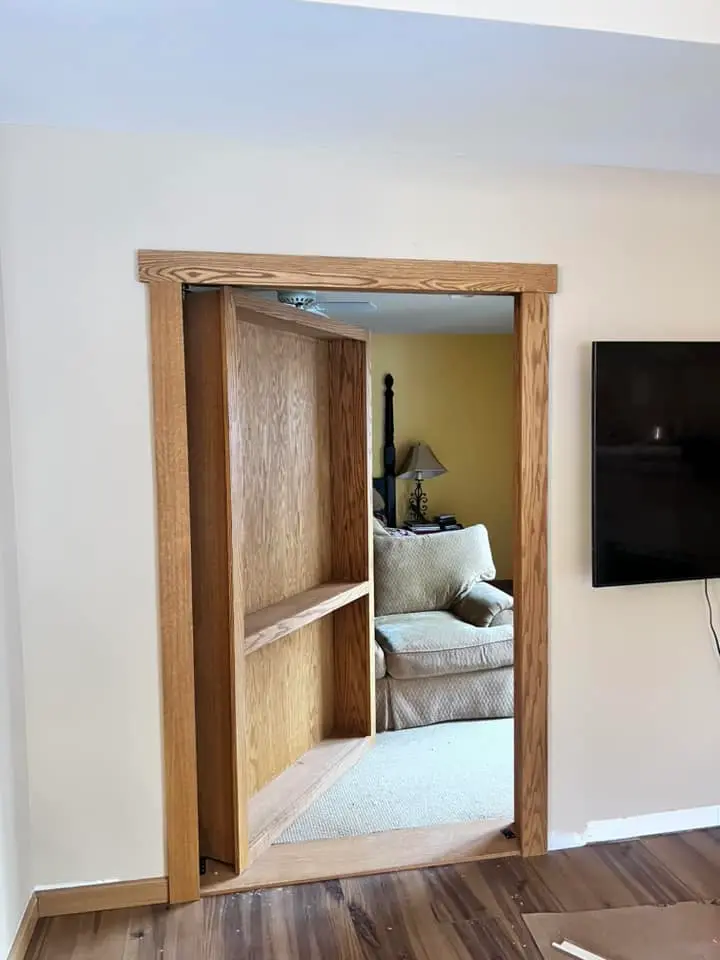
An oak bookcase Edgar built that swings open as a hidden door.
Custom Carpentry questions
Can you build a bookcase that works as a hidden door?
Do you build ski and gear storage for mudrooms?
Can you match trim and woodwork already in my home?
What wood is best for built-ins in a dry mountain climate?
Are pieces built in a shop or on site?
Related services
Tell Edgar about the job
Send a few details and the town you are in. Edgar calls you back to talk through scope, timing and the next step, and the estimate is free.
Monday to Friday, 7:00 am to 6:00 pm.